
PocketGuard review: the virtue of a useful boundary
A confident daily spending guardrail for people who want less to interpret—and can accept a narrower view.
PocketGuard is an excellent spending-control app and our 4.5/5 second choice for 2026. Its “In My Pocket” calculation turns income, bills, goals, and budgets into a practical available-to-spend number. Empower remains stronger overall because it offers broader reporting and investment context for free.
A budget can be a map, or it can be a fence. PocketGuard is the fence: it takes several moving parts and answers the close-at-hand question, “What can I spend without colliding with the rest of the month?” Across 32 days and 287 transactions, that answer was usually conservative, legible, and more useful than another decorative chart.
We used the official PocketGuard app from June 20 to July 21, 2026 on Android and web, connecting checking, savings, two credit cards, and a personal loan. We created category budgets, adjusted a pay date, added three goals, marked bills, searched transactions, and tested export and support. Pricing was rechecked August 5.
What works
- A genuinely useful available-to-spend figure
- Flexible category limits and rollover options
- Good recurring-bill and subscription visibility
- Debt payoff planning adds concrete momentum
What does not
- Best controls sit behind Plus
- Less investment and net-worth depth than Empower
- Limited equal-access household collaboration
- Annual price needs to earn its place
The weighted result
| Category | Weight | Score | Weighted points |
|---|---|---|---|
| Account coverage & reliability | 25% | 4.4 | 1.10 |
| Planning & cash flow | 25% | 4.8 | 1.20 |
| Daily usability | 20% | 4.7 | 0.94 |
| Insight & reporting | 15% | 4.0 | 0.60 |
| Value | 10% | 4.1 | 0.41 |
| Privacy & support | 5% | 5.0 | 0.25 |
| Total | 100% | 4.50/5 |
A number that earns its prominence
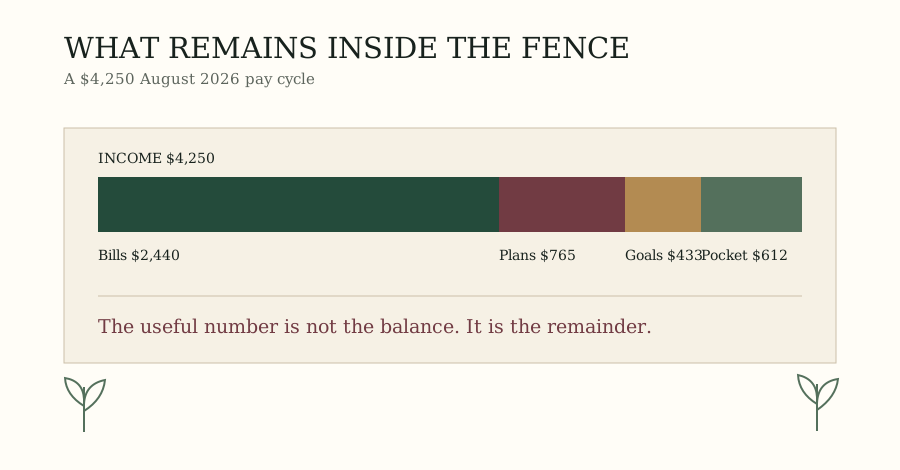
In My Pocket starts with expected income, then accounts for bills, goals, and planned spending. The result is not novel mathematics; its value lies in maintenance. A changed utility bill or delayed paycheck can be corrected without rebuilding the whole plan. When our tester moved a freelance payment five days later, the available amount tightened immediately rather than pretending calendar months are smooth.
Accuracy depends on housekeeping. A missing annual bill made the first week look $142 more comfortable than it was. Once the bill was added, the figure behaved well. PocketGuard is therefore automated, not autonomous. Spend ten minutes each week confirming transactions and future bills, especially in the first month.
Budgeting with enough flexibility
Category budgets are clearer than Empower’s one total target. Rollover can preserve unspent room, and custom categories make the plan reflect a real household instead of a generic taxonomy. Transaction rules reduced repeated corrections; 93% of our ordinary purchases were acceptably categorized after the second week.
The debt-payoff feature turns balances, rates, and payments into an estimated path. It is useful for comparison, though it cannot know whether an emergency expense will interrupt that path. Treat the projected date as a plan under stated assumptions, not a promise. For definitions of interest, cash flow, and sinking funds, our plain-English glossary supplies the missing context.
Price changes the equation
A limited version can be explored for free. PocketGuard Plus was listed at $12.99 monthly or $74.99 annually on August 5, 2026; platform and regional offers may differ. The annual plan is much easier to justify than paying month to month, but only if the central guardrail changes decisions often enough to cover roughly $6.25 per month.
Empower’s comparable aggregation and cash-flow layer costs $0, while YNAB asks more but delivers a deeper allocation method. PocketGuard occupies the middle: simpler than YNAB, more prescriptive than Empower. See our direct comparison for a closer view of those differences.
Sync and daily experience
Four of five connections were quiet throughout the test. One card stopped refreshing for roughly 36 hours and recovered after reauthentication. Search was fast; editing merchant names and categories required few taps. Notifications were useful after pruning, but the default set felt busy. We kept bill alerts and disabled general progress encouragement.
Reporting explains where money went but offers less historical and investment context than Empower. That is not necessarily a defect. A person susceptible to dashboard tourism may benefit from an app that returns to the same boundary instead of presenting another lens.
Our verdict
PocketGuard earns 4.5/5: strongly recommended for people who overspend between bills or need a forgiving alternative to strict zero-based budgeting. It finishes behind Empower because it charges for its best planning tools and sees less of a financial life. If the daily number prevents even one avoidable purchase a month, the annual price can still be rational.
Frequently asked questions
How much does PocketGuard cost in 2026?
PocketGuard offers a limited free experience, while PocketGuard Plus was listed at $12.99 per month or $74.99 per year when we checked on August 5, 2026. Offers can vary by platform and region. Check the checkout screen before subscribing, and judge the annual plan only after using the free version through a full pay cycle.
What does PocketGuard’s In My Pocket number mean?
In My Pocket estimates what remains available after income, recurring bills, savings goals, and planned spending are considered. It is a useful guardrail, not a bank balance or permission slip. Its quality depends on complete account connections and accurate bill dates, so review the underlying plan whenever the number looks surprisingly generous or severe.
Is PocketGuard better than Empower?
PocketGuard is better for explicit category limits and a simple daily spending allowance. Empower is better for the complete financial picture: investments, net worth, cash-flow trends, and retirement planning. Our weighted tests put PocketGuard at 4.5 and Empower at 4.8. The narrow score gap conceals a meaningful difference in purpose.
Can couples use PocketGuard together?
PocketGuard works best as one person’s consolidated plan. A couple can connect shared accounts, but its collaboration is not as developed as tools designed around household access and separate logins. Partners who need equal, distinct access should compare Monarch Money, YNAB Together, or Goodbudget before paying for an annual PocketGuard subscription.
Compare all seven contenders in our best budgeting apps ranking, then use our eight-question selection guide to identify the features that matter.