
On enough: notes toward a finished budget
A monthly plan should tell the truth, hold some weather, and eventually permit its maker to close the tab.
A budget is finished when it can survive an ordinary Tuesday without further debate. It covers known bills, names a few genuine priorities, leaves 5% to 10% breathing room, and makes the next decision clear. More categories, forecasts, and adjustments do not necessarily make it more complete.
Enough is an unfashionable financial word. It places a boundary where software prefers an upward arrow. It does not mean abundance, resignation, or the end of ambition. It means the present plan has answered the present question and may now be left alone.
On August 1, 2026, I watched a household revise a $4,000 monthly budget for the ninth time. The grocery line moved from $520 to $500, then back to $520. Entertainment became “Culture” and “Streaming,” as if a better taxonomy could make a Saturday cheaper. Nothing about the next purchase changed.
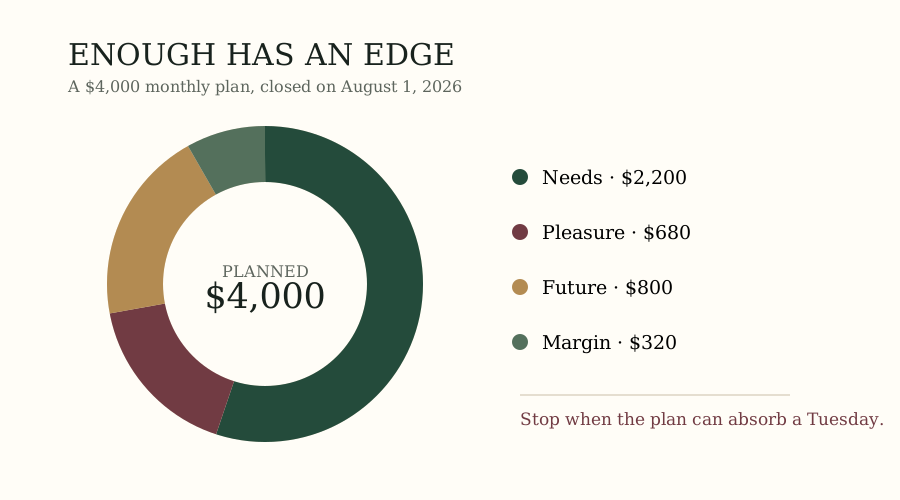
The plan already held $2,200 for needs, $680 for pleasure, $800 for saving and debt reduction, and $320 of margin. It was not perfect because September had not happened. It was complete because every known obligation had a place and uncertainty had one too.
Completion is a financial feature
Most budget advice concerns construction: gather income, list bills, set categories, allocate the difference. Less is said about stopping. Without a stopping rule, planning becomes a low-grade form of vigilance. The budget remains open because another possible expense can always be imagined.
A finished plan has three conditions. First, it is arithmetically true: assigned spending does not exceed available income. Second, it is temporally true: the dates of pay and bills can coexist without an avoidable overdraft. Third, it is behaviorally useful: a person knows what to do when the next grocery, invitation, or repair arrives.
| Question | Finished answer | Signal to keep working |
|---|---|---|
| Are known bills covered? | Amount and due date are present | A recurring bill is estimated or missing |
| Are priorities visible? | One to three transfers are scheduled | “Save more” has no amount or date |
| Can timing work? | Lowest projected balance stays above $0 | Month total works but payday sequence does not |
| Is there margin? | 5%–10% remains flexible | Every dollar depends on perfect conditions |
| Will another edit change action? | No: close the plan | Yes: make that edit, then stop |
The dignity of slack
Efficiency has a clean reputation. In a household, it can be brittle. A plan allocating 100% of income to narrowly named jobs may be mathematically elegant and practically exhausted. School requests $18 by Friday; the pharmacy copay is $12 higher; a friend visits. Each event becomes a category failure instead of ordinary weather.
Margin is the budget’s uncultivated edge. For steady income, 5% to 10% of take-home pay is a reasonable starting range. On $4,000, that is $200 to $400. A variable-income household may need 15% in stronger months, held against weaker ones. The amount is not sacred. The principle is that uncertainty deserves funding before it acquires a name.
This differs from an emergency fund. Emergency savings stands outside the month for high-impact disruption. Margin lives inside the month and handles the small inaccuracies that otherwise invite constant redrafting.
Enough does not forbid change
A finished budget is not sealed. If rent rises on August 15, the plan changes. If income arrives $300 short, the plan changes. The stopping rule concerns imagined refinement, not new evidence. A gardener stops arranging the beds but still opens the gate when weather comes.
Nor does enough require identical desires. One household’s finished pleasure line is another’s deprivation. A workable budget can include $180 for restaurants and $0 for a gym, or the reverse. Our four-month spending ledger found leverage in delivered meals, not café coffee. The honest unit is the life being financed.
The finished budget in practice
Set a 30-minute planning appointment before the month begins. Enter known income, fixed bills, minimum debt payments, and chosen transfers. Estimate flexible needs from the last three months, not an aspirational month. Add a margin line. Then ask which remaining uncertainty would actually alter a decision.
On August 1, the household’s ninth revision was reversed. Groceries returned to $520; streaming remained inside entertainment; the $320 margin stayed unnamed. Automatic transfers of $400 to emergency savings and $200 toward extra principal were scheduled for August 3. The document was marked finished at 8:42 p.m.
By August 5, nothing dramatic had happened. That is favorable evidence. Two grocery purchases totaled $86.14, one annual museum renewal used $75 of the pleasure line, and no one reopened the plan. A budget sometimes succeeds by withdrawing from attention.
A modest philosophy
Make the budget accurate enough to trust, spacious enough to bend, and limited enough to finish. Its purpose is not to occupy the mind with money. Its purpose is to return the mind to everything money quietly supports.
Frequently asked questions
When is a monthly budget finished?
It is finished when every known obligation and chosen goal has a place, cash timing works, the plan retains realistic margin, and another adjustment would not change a decision. New facts can reopen it; vague unease need not.
How much margin should a budget have?
For a stable-income household, 5% to 10% of take-home pay is a useful starting range. Variable income, irregular bills, or an early emergency-fund stage may justify more. Review actual use after three months.
Is an unspent category a budgeting mistake?
No. Unspent money can roll forward, support another priority, or remain as margin. A budget is a plan, not a consumption quota. The correct response depends on what the money must do next.
If software keeps the plan permanently open, our budgeting-app selection guide includes a simpler four-week trial.