
Empower’s dashboards, considered
Notes on the promise and peculiar calm of seeing cash, debt, investments, and tomorrow gathered in one financial field.
Empower’s dashboard is most useful as a weekly observatory, not a daily cockpit. Across 30 days ending August 4, 2026, its joined view exposed a $38 subscription, a costly fund, and a cash surplus. It improved perspective more than behavior—and that distinction is the reason to use it.
A dashboard makes a quiet philosophical claim: these different things belong on one surface. The checking account that buys groceries, the retirement account intended for 2054, the credit card closing Friday, and the mortgage measured in decades become neighbors. Sometimes that arrangement produces knowledge. Sometimes it produces weather anxiety with better typography.
This diary followed one test household from July 6 through August 4, 2026. Six institutions supplied 19 accounts and 391 transactions. The household opened Empower deliberately on Mondays and after two unusual events; notification email was disabled. This was not another product score—our complete Empower review contains the weighted test—but a study of attention.
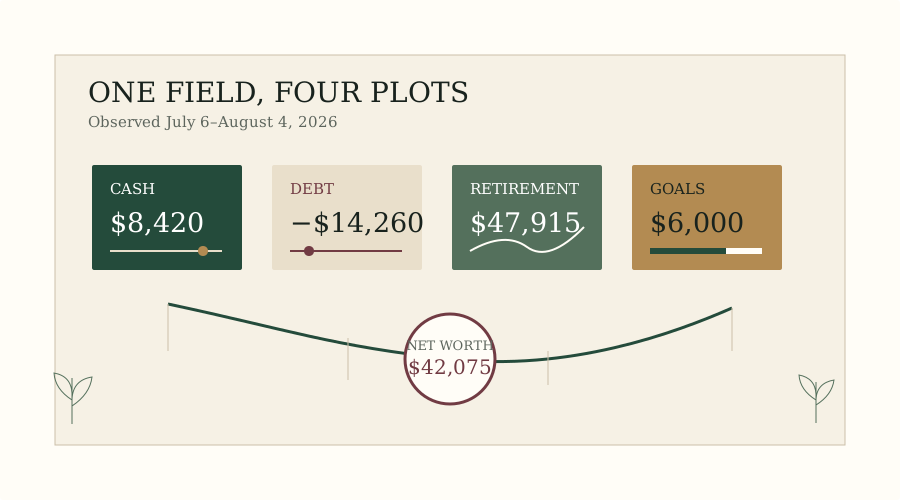
July 6: the first clearing
The initial net-worth number was wrong by $21,740 because an old workplace retirement plan had imported twice. That error matters less as an indictment of aggregation than as a rule: a dashboard deserves no authority until every account is named, dated, and reconciled. We hid the duplicate, marked the house as an asset only after checking the valuation date, and confirmed every debt balance.
Once corrected, the surface did what a spreadsheet rarely does: it made the relationship between cash and long-term assets immediate. The household was not “behind” because checking had fallen after rent; checking was doing its seasonal work while retirement assets remained intact. Scale restored proportion.
July 13: one weed, clearly seen
Cash-flow categories showed $86 in “Business services.” Three transactions belonged there; one $38 charge did not. It was an annualized monthly subscription left from a finished project. Cancellation took four minutes. This is the dashboard’s most credible return: not constant optimization, but occasional recognition. One found charge covered the time spent reviewing the month.
The category editor remained broad. A restaurant purchase could become “Dining,” but the system did not comfortably distinguish weekday convenience from a planned anniversary. For that kind of boundary, PocketGuard or YNAB is a better instrument. Our Empower and PocketGuard comparison describes the difference as perspective versus restraint.
| Date | View opened | Observation | Action |
|---|---|---|---|
| July 6, 2026 | Net worth | Duplicate retirement account | Excluded $21,740 duplicate |
| July 13 | Cash flow | Forgotten $38 subscription | Canceled before renewal |
| July 20 | Investments | Fund expense ratio of 0.71% | Added to review list; no hasty trade |
| July 27 | Planning | $640 above cash target | Moved $400 to emergency savings |
| August 4 | Transactions | Three pending items settled correctly | No correction needed |
July 20: the expensive patch
The investment fee analyzer identified a legacy fund charging 0.71% a year. On a $12,400 balance, that is roughly $88 annually before compounding. The dashboard made the cost legible, but not the decision. Taxes, trading restrictions, and equivalent replacements still required investigation. Visibility supplied a question; it did not supply fiduciary judgment.
That distinction applies throughout. The retirement planner can model a 6% return and a 3% inflation rate, but a smooth line is not a forecast. The cash-flow view can show an $820 surplus, but not whether the roof has begun to leak. Financial software is strongest when it remembers and calculates. Human context remains stubbornly local.
July 27: a number becomes a movement
The cash dashboard showed $640 above the household’s chosen checking floor after upcoming bills were considered. We moved $400 into emergency savings and left $240 as margin. Nothing in Empower compelled that split. The broad view simply made the idle cash visible beside an unfinished goal.
This was the month’s most constructive moment, partly because it ended in an action outside the dashboard. A financial tool should sometimes make itself unnecessary. Once the transfer cleared on July 29, the household did not reopen the app to admire the new number.
August 4: closing the gate
At the end of 30 days, the household had opened Empower seven times: four planned Monday reviews, two event checks, and one month-end reconciliation. That cadence was sufficient. The accounts refreshed reliably, the three pending purchases settled without duplicates, and net worth rose $1,126—mostly market movement and retirement contributions, not a verdict on the month.
The lesson was not to see everything all the time. It was to have one trusted place where everything could be seen when a decision required it. A dashboard earns its space by shortening uncertainty, then releasing attention back to life.
Considered as an instrument
Empower is a good telescope and a mediocre fence. Use it weekly to reconcile the whole financial field, inspect fees, and notice drift. Do not ask it to enforce detailed category intentions or interpret every market tremor. The whole view is valuable precisely when it does not become the whole day.
Frequently asked questions
What does Empower’s dashboard show?
It combines linked checking, savings, credit, loan, mortgage, and investment accounts into views of net worth, cash flow, transactions, holdings, fees, and retirement planning. Coverage depends on which institutions connect successfully and whether balances are reconciled.
Is Empower detailed enough for category budgeting?
Not for a strict category plan. Its budgeting view works well for observing total monthly spending and broad categories, but it lacks the envelope depth of YNAB and the daily spending boundary of PocketGuard.
How often should you check a financial dashboard?
Weekly is frequent enough for most households, with a deeper review after each month closes. Check sooner after an unusual transaction or account alert. Daily viewing often magnifies harmless market and pending-transaction noise.
If the joined view feels too broad, begin with our eight-question app guide and name the one decision the tool must improve.